Effect of pore pressure on compressional velocities of volcanic rocks
Journal of Volcanology and Geothermal Research | 2026
Authors: Shreya Kanakiya and Ludmila Adam
DOI: https://doi.org/10.1016/j.jvolgeores.2026.108640
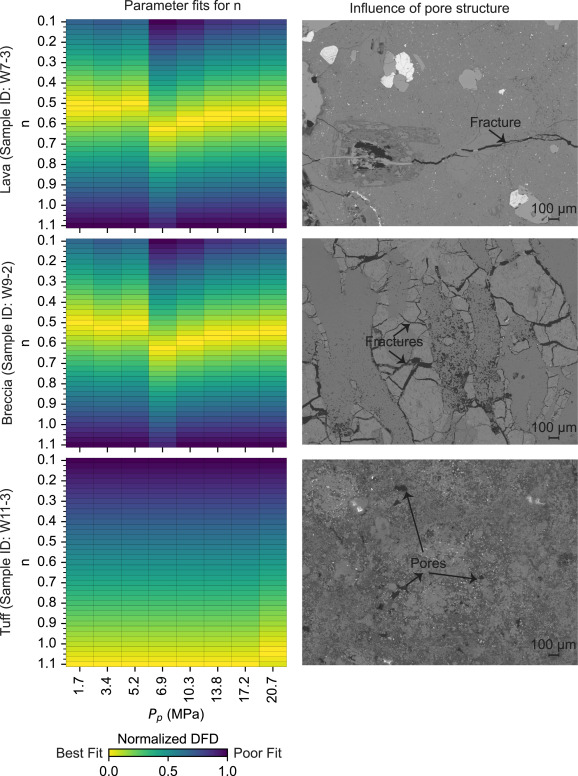
Volcanoes with active hydrothermal systems exhibit complex and variable patterns in ground deformation, fluid flow, and gas emission. Interpreting these patterns from geophysical monitoring data requires a robust understanding of how subsurface pressures control the poroelastic behavior of volcanic rocks, which are subject to repeated stress cycles and changing pore pressure conditions. A common, but simplified, assumption is that all subsurface rocks experience the same effective pressure for a given combination of confining and pore pressures - that is, the effective stress coefficient (n) is assumed to be 1. Here, we investigate the poroelastic behavior of three common lithologies from White Island (Whakaari) volcano, New Zealand: andesitic lavas (porosity=13%), breccias (porosity=19%), and tuffs (porosity=32%–34%). We measured P-wave velocity (Vp) under a range of confining and pore pressure conditions to experimentally determine the effective stress coefficient for each rock type. Furthermore, we quantified changes in porosity through multiple cycles of confining pressure up to 55 MPa to assess their mechanical response and hysteresis effects. Our results reveal a significant lithological and pore structure dependence: the effective stress coefficient for Vp ranges between 0.5 and 0.6 for fracture-dominated low porosity lavas and breccias, but approaches 1 for the porous tuffs. This finding demonstrates that the effective stress coefficient for volcanic rocks varies significantly with lithology and pore structure. These variations have critical implications for accurately determining the true stress state and mechanical stability of a volcanic edifice under dynamic hydrothermal conditions.
Highlights
- Poroelastic response of volcanic rocks under varying confining and pore pressure is studied.
- Effective stress coefficient for P-wave velocity of volcanic rocks varies from 0.5 to 1.1.
- The effective pressure experienced by rocks in the edifice varies based on their pore structure.
FAQ
Where can I find the samples used in this study?
The samples are at the Physics of Rock Lab at the University of Auckland.
Where can I find the data from this study?
All data from this study are available in the online open-access repository — figshare. Citation: Kanakiya, S. (2026). [Dataset] Poroelastic Response of Volcanic Rocks: Implications for Edifice Stress and Stability. https://doi.org/10.6084/m9.figshare.30421909